
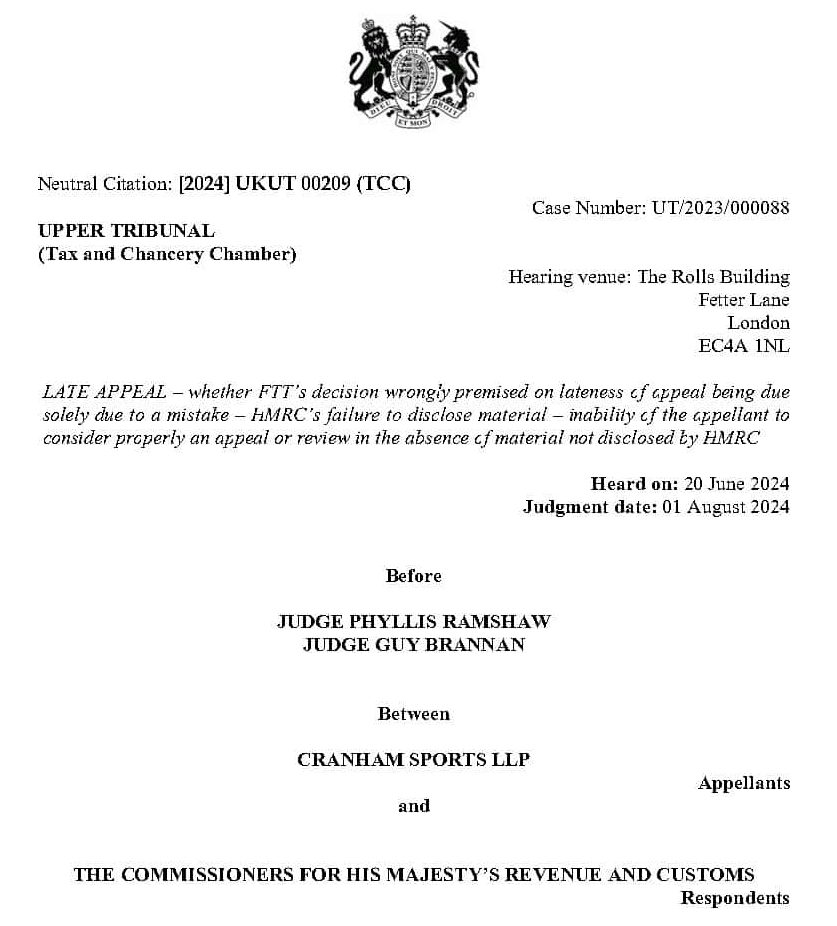
The judgment handed down by the Tax Tribunal in relation to the IR35 intermediaries legislation case of Cranham Sports LLP v HMRC [2024] UKUT 00209 (TCC)) serves as a stark reminder of the critical importance of strict adherence to statutory time limits in tax appeals. The ruling highlights how tax advisers’ (i.e. non-solicitors) procedural failures can result in irreversible loss of appeal rights, even where the underlying tax position may be arguable.
The decision reinforces the principles established in Martland v HMRC regarding late appeal applications and demonstrates the harsh consequences when tax tribunal procedures are not properly followed. This case particularly emphasises the risks faced by contractors and commentators operating through intermediaries when their professional representatives fail to act within prescribed deadlines, as seen in other professional negligence claims involving tax advisory services.
HMRC TAX DISPUTES LEGAL ADVICE & DEFENCE
Our lawyers have a track record of successfully challenging HMRC decisions and will assist you to get an optimal result. We analyse the merits at the very outset in an initial video conference together with leading (ex-HMRC and Big 4) tax litigation counsel. We provide urgent advice and representation to clients from our unique expert team of established Tax specialist solicitors and barristers with a proven track record of delivering results. Call us on +442071830529, or email contact@lexlaw.co.uk.
Background of the IR35 Engagement: Cowan’s Relationship with Sky
Cranham Sports LLP was established on 24 August 2009 as a limited liability partnership with Barry Cowan, a former professional tennis player turned Sky Sports commentator, as a member. The case centered on Cowan’s services as a tennis commentator for Sky UK Limited from around 2013, with HMRC’s investigation covering the 2013/14 to 2018/19 tax years and the application of IR35 intermediaries legislation to these arrangements.
HMRC conducted a comprehensive review of the contractual arrangements between Cranham Sports LLP and Sky Sports, ultimately determining that under the IR35 rules, Cowan should be treated as an employee of Sky rather than a genuine self-employed contractor. This determination resulted in HMRC issuing regulation 80 determinations under the Income Tax (Pay as Your Earn) Regulations 2003 and notices under section 8 of the Social Security and Contributions (Transfer of Functions) Act 1999, demanding additional income tax and Class 1 National Insurance contributions.
The timeline of correspondence proves crucial to understanding how procedural errors developed. On 17 June 2021, HMRC issued its initial opinion concluding that IR35 applied to Cowan’s arrangements, giving the taxpayer until 19 July 2021 to respond with any disagreements. Cranham Sports’ representative, Mr Leslie, responded on 8 July 2021 with a detailed email containing 23 disputed points, describing HMRC’s decision as “unsafe and completely incorrect”. However, HMRC failed to respond to these detailed challenges, instead issuing a “view of the matter” letter on 8 December 2021, which clearly stated the taxpayer’s options and the 30-day deadline for action.
DOWNLOAD THE PDF JUDGMENT HERE:
Key Findings in Cranham Sports LLP v HMRC
The Tax Adviser’s Critical Procedural Failure
The First-tier Tribunal found that despite receiving clear instructions about statutory deadlines, the taxpayer’s professional representative failed to take timely action. Judge Phyllis Ramshaw and Judge Guy Brannan noted in their judgment: “The representatives in this case were chartered accountants acting for the Appellant in connection with its tax affairs and should have been, and were in any event, were made aware of the statutory time limit in which to request a review or notify an appeal”. The judges emphasised at paragraph 41 that: “Acting prudently, a competent professional could have been expected to have protected the Appellant’s position by formally asking for an internal review even were the view held that the view of the matter letter was inadequate”.
Application of Martland Principles
The Upper Tribunal confirmed that the First-tier Tribunal had correctly applied the three-stage Martland test for late appeals. This established framework requires consideration of: (1) the length of delay, (2) the reasons for delay, and (3) all circumstances of the case in a balancing exercise. The judges found that a 60-day delay against a 30-day statutory limit constituted a serious delay requiring detailed examination of the second and third stages.
Rejection of HMRC Non-Disclosure Arguments
The Upper Tribunal rejected arguments that HMRC’s failure to disclose material from Sky Sports justified the delay. The judges found at paragraph 52 that whilst the taxpayer had requested Sky documentation and considered it important, this did not excuse the failure to protect appeal rights: “I consider that had the appeal been notified within a reasonable period after 25 January 2022 I would have granted permission firstly because the period of delay would have been short and secondly because I consider that the conflict in the letter as to dates and the without prejudice correspondence could have created an impression to the representative and his client that the time limit was not running”.
Implications of Cranham Sports LLP v HMRC
This decision reinforces the unforgiving nature of statutory time limits in tax appeals and demonstrates how professional negligence in tax matters can have devastating consequences for clients. The Upper Tribunal’s dismissal of the appeal confirms that even where taxpayers may have strong substantive arguments, procedural failures by their advisers can permanently bar access to justice. The case highlights a growing trend where courts are increasingly unwilling to excuse delays caused by professional representatives’ errors, as seen in similar decisions involving tax dispute procedures.
The judgment serves as a warning to all contractors operating through intermediaries that their choice of professional adviser is critical to protecting their interests. The case demonstrates that ongoing correspondence with HMRC does not suspend statutory deadlines and that formal procedural steps must be taken within prescribed time limits regardless of the substantive negotiations taking place. This principle has broader implications for all taxpayers facing investigations or assessments where appeal rights are time-limited.
The decision also highlights the importance of proper case management in IR35 disputes, where the stakes are often high and the legal landscape complex. Professional advisers acting in such matters must maintain rigorous deadline management systems and cannot rely on assumptions about HMRC’s conduct or ongoing dialogue to protect their clients’ procedural rights. The case reinforces that the burden lies squarely on taxpayers and their representatives to comply with statutory requirements, regardless of perceived deficiencies in HMRC’s handling of the matter.
ACCOUNTANTS HAVE NO LEGAL DUTY OF CONIFDENTIALTY
Unlike a solicitor who by law must provide an entirely confidential legal service, an accountant has no legal duty of confidentiality and will have little to no skill in managing tax litigation; we have seen numerous cases where an accountant has disclosed material that we as solicitors would not be able to disclose and also worsened the client’s position with HMRC. Our team of ex-HMRC barristers and solicitors can carefully manage tax disputes by reviewing and providing additional documentation, clarifying positions, or negotiating a settlement with HMRC. In some cases, taxpayers may appeal decisions to independent tax tribunals or courts if an agreement cannot be reached through negotiation. Alternative dispute resolution mechanisms, such as HMRC mediation, may be explored as a way to resolve conflicts outside of formal legal proceedings.
Expert HMRC IR35 Defence Lawyers
When facing IR35 investigations, early identification of all relevant deadlines and implementation of robust case management systems becomes paramount to protecting taxpayer rights. Professional advisers must maintain comprehensive deadline diaries that account for all statutory time limits, including the crucial 30-day periods for requesting reviews or notifying appeals under sections 49B and 49C of the Taxes Management Act 1970. The establishment of multiple reminder systems and clear delegation of responsibilities within advisory teams can prevent the type of oversight that proved fatal in Cranham Sports.
Immediate protective action should be taken upon receipt of any HMRC determination or view of the matter letter, even where substantive negotiations are ongoing. This includes formally requesting internal reviews within prescribed deadlines whilst simultaneously preparing comprehensive responses to HMRC’s technical arguments. Advisers should never assume that ongoing correspondence or settlement discussions suspend statutory deadlines, as demonstrated by the harsh consequences in this case.
Where procedural errors do occur, immediate damage limitation becomes essential, including prompt applications for late appeal permission with comprehensive evidence supporting reasonable excuse arguments. However, the Cranham Sports decision demonstrates the difficulty of succeeding with such applications, particularly where the delay extends beyond what tribunals consider reasonable. Advisers must therefore focus on prevention rather than cure, implementing systems that make procedural failures virtually impossible rather than relying on the tribunal’s discretion to excuse errors after they occur.
Expert London Tax Litigation Lawyers
Contact our experienced tax dispute resolution team today for a confidential discussion and expert legal guidance on 02071830529 or email us at taxdisputes@lexlaw.co.uk. We are here to help you understand your obligations, navigate HMRC scrutiny, and protect your interests in all tax-related litigation matters.
Want legal advice from Tax Solicitors on your case?
Our simple enquiry form goes immediately to our tax litigators in Middle Temple, London. Call us on +442071830529 from 9am-6pm.
Frequently Asked Questions:
Can I blame my tax adviser/ accountant for missing the appeal deadline?
The Tribunal reaffirmed that taxpayers bear ultimate responsibility for compliance. If your adviser fails to act, the consequences fall on you. However, you may have a claim in professional negligence against the adviser.
What is a “valid notice of appeal”?
It must meet all statutory requirements: be in writing, signed, state the grounds of appeal clearly, and be served within the 30-day deadline. Informal letters or emails are not sufficient unless they meet all conditions.
Is IR35 a discretionary assessment or mandatory?
IR35 applies mandatorily where the conditions are met. However, the assessment involves judgment and fact-finding. Procedural failures, like in this case, mean those factual disputes are never considered.
Why is this case significant for IR35 contractors and their advisers?
The Cranham Sports decision establishes a crucial precedent regarding the absolute nature of statutory deadlines in IR35 appeals and the consequences of professional advisers’ procedural failure. This case demonstrates that even highly experienced chartered accountants can make errors that permanently deny clients their appeal rights, regardless of the strength of their substantive arguments. The significance extends beyond IR35 to all areas of tax dispute resolution where statutory time limits apply, serving as a stark reminder that procedural compliance cannot be treated as secondary to substantive legal arguments. For contractors, the case highlights the critical importance of selecting advisers with robust case management systems and deep understanding of tribunal procedures, as the consequences of errors can be financially devastating and legally irreversible.
How do statutory time limits apply to different stages of IR35 disputes?
IR35 disputes involve multiple critical deadlines under various statutory provisions, each carrying severe consequences for non-compliance. The initial 30-day period for appealing HMRC determinations under section 31A of the Taxes Management Act 1970 represents the first crucial deadline, failure to meet which results in the assessment becoming final. Where HMRC offers internal reviews under section 49C, taxpayers have 30 days to accept the offer, failing which the matter is deemed settled by agreement. Following review conclusions, taxpayers have a further 30 days under section 49F to notify appeals to the First-tier Tribunal, with late appeals requiring tribunal permission under strict criteria established in Martland v HMRC. Understanding these interconnected deadlines and their consequences is essential for both advisers and clients in managing IR35 disputes effectively.
What do I do if the appeal deadline has passed?
Seek legal advice urgently. While late appeals may sometimes be permitted under s.49 TMA 1970, the threshold is high. Tribunals look at reasons for delay, length of delay, and prejudice caused.