
The Commercial Court’s decision in Skatteforvaltningen v Solo Capital Partners [2025] EWHC 2364 (Comm) represents a significant victory for defendants accused of orchestrating sophisticated tax fraud, demonstrating that even in cases involving allegations of massive fraudulent schemes, claimants must prove that they were actually misled by false representations. After what became the longest trial in Commercial Court history, spanning 108 hearing days over 13 months, Mr Justice Andrew Baker dismissed all claims brought by the Danish tax authority (SKAT) against the defendants, except for one default judgment.
This ruling provides crucial guidance on the requirements for establishing misrepresentation and inducement in high-value fraud cases, the operation of cum-ex trading schemes, and the standards tax authorities must meet when pursuing civil recovery actions. The judgment underscores that sophisticated control failures by public authorities can undermine their ability to establish the reliance element necessary for fraud claims.
Want legal advice from Tax Solicitors on your case?
Our simple enquiry form goes immediately to our tax litigators in Middle Temple, London. Call us on +442071830529 from 9am-6pm.
Background to the Dispute
The case arose from Denmark’s pursuit of approximately £1.4 billion in tax refunds paid out through sophisticated “cum-ex” trading schemes between August 2012 and July 2015. SKAT alleged that Solo Capital Partners, founded by trader Sanjay Shah, orchestrated complex dividend arbitrage operations designed to exploit weaknesses in Denmark’s withholding tax system.
The cum-ex schemes operated by capitalising on the brief period around dividend payment dates when shares could be traded rapidly between multiple parties, creating artificial settlement loops that generated dividend credit advice notes without any actual shareholdings changing hands. This allowed tax refund claims to be made to SKAT based on “synthetic” shareholdings that never actually existed.
SKAT’s case centred on allegations of fraudulent misrepresentation, claiming that the defendants had deliberately misled the Danish tax authority about share ownership to induce improper tax refund payments. The Danish authority argued that each refund claim contained implied representations that the claimants were legitimate shareholders entitled to dividend tax relief under applicable double taxation treaties.
The Settlement Loop Methodology
The court’s technical analysis revealed that all the trading involved “share-less settlement loops” where custodians processed transactions internally without any actual shares ever changing hands. As the judge explained: “This was share trading by parties with neither shares nor money, settled at a custodian with neither shares nor money, by and through which neither shares nor money ever changed hands.”
The court found that buyers contracted to purchase shares cum-dividend (before the record date) for settlement ex-dividend (after the record date), but these purchases were settled through complex circular arrangements involving stock loans and forwards that meant no actual shareholdings were ever transferred.
SKAT’s Institutional Control Failures
Critically, the court found that “SKAT’s controls for assessing and paying dividend tax refund claims were so flimsy as to be almost non-existent.” The evidence showed that:
- A single civil servant, Mr Nielsen, processed the 4,170 claims worth £1.4 billion as “a straightforward clerical matter”
- SKAT paid claims without examining the underlying trading arrangements
- The system was designed to pay out based on minimal documentation
- Tax agents’ cover letters explaining the arrangements “may as well have said nothing”
The court concluded that SKAT knew representations of share ownership were not being made to it, and that it was paying claims anyway without regard to whether the strict legal requirements were met.
The Burden of Proving Inducement
The judgment emphasises a crucial principle for fraud cases: claimants must prove they were actually misled by false representations, not merely that false representations were made. The court found that:
“SKAT was not misled by misrepresentations made to it through the tax refund claims it received, as it alleged… SKAT was not induced to act, at all, by the representations it alleged in these proceedings.”
This finding was based on evidence that SKAT’s process was essentially mechanical, with no genuine consideration of whether the claimed shareholdings existed or whether tax liabilities had actually been incurred.
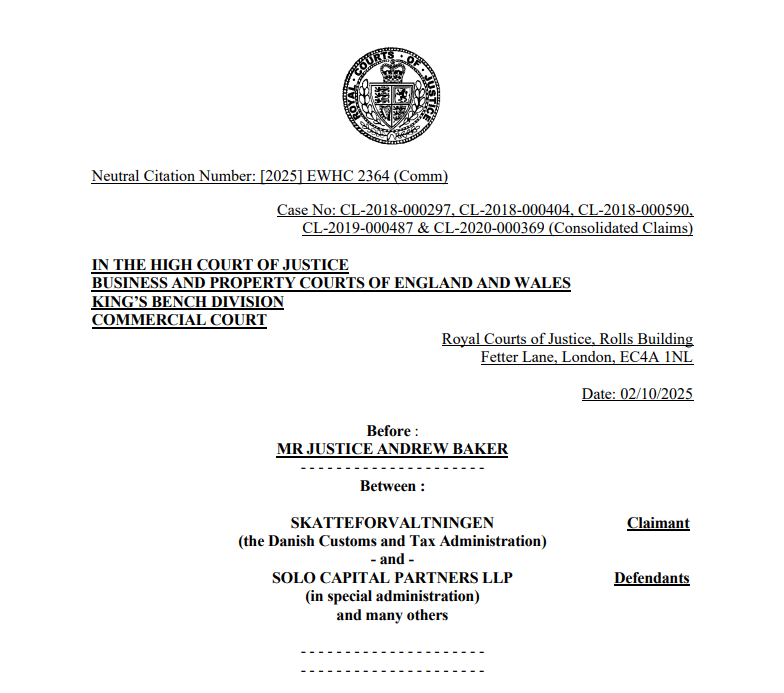
Please find the full judgment here:
Legal Principles and Findings
No Reasonable Belief in Validity
While dismissing SKAT’s fraud claims, the court made significant findings about the defendants’ knowledge and belief systems. Mr Justice Baker concluded:
- Sanjay Shah, Graham Horn and Rajen Shah: The court rejected their evidence that they believed the tax refund claims were valid under Danish tax law
- Guenther Klar: The court accepted he believed the claims were valid but found he had no reasonable basis for this belief
- Other participants: Many were found to have engaged in “collateral dishonesty” and obfuscation
However, the judge emphasised: “My rejection of narratives put forward by many of the trial defendants… does not prove the case pleaded by SKAT and pursued by it at trial.”
The “Street Sign” Analogy
The court referenced Sanjay Shah’s 2021 interview comment about the Danish situation: “If there’s a big sign on the street saying, ‘please help yourself’, then me or somebody else would go and help themselves.”
Mr Justice Baker found this was an accurate assessment – that the defendants exploited SKAT’s weak control systems rather than deliberately deceiving the authority through false representations.
Implications for Commercial Fraud Defence
This judgment has significant implications for defendants facing fraud allegations from public authorities, particularly in cases involving complex financial arrangements and systemic institutional failures.
Requirements for Inducement: The decision confirms that courts will require clear evidence that alleged misrepresentations actually influenced the claimant’s decision-making process. Where authorities operate mechanical approval systems without genuine consideration of the matters allegedly represented, inducement cannot be established.
Institutional Competence as Defence
The case demonstrates how institutional failures by claimant authorities can provide powerful defences to fraud allegations. Where authorities implement inadequate systems that ignore key information, they may struggle to establish they were genuinely misled.
The court’s findings about SKAT’s “flimsy” controls that were “almost non-existent” show how system design evidence can defeat inducement claims even where the underlying transactions lack commercial substance.
Complexity vs. Misrepresentation
The judgment illustrates that complex or artificial commercial arrangements do not automatically constitute misrepresentation. The court carefully distinguished between:
- Arrangements designed to exploit regulatory weaknesses (which may be permissible)
- Arrangements involving false statements designed to mislead authorities (which constitute fraud)
Why This Case Matters
The Skatteforvaltningen decision represents a rare but significant victory for defendants in a major fraud case brought by a tax authority. The judgment provides several key lessons for commercial litigation practice:
Institutional process evidence is crucial: The detailed examination of SKAT’s approval process proved decisive in defeating the inducement claim. Defendants should carefully examine claimant systems and decision-making processes.
Burden of proof remains high: Even where defendants’ conduct appears questionable and arrangements lack commercial substance, fraud claimants must still prove all elements of their case to the required standard.
System design defeats reliance: Where claimants operate mechanical systems that ignore key information, this can provide compelling evidence against inducement, even where prima facie misleading documents were submitted.
The case also demonstrates the importance of sustained, expert legal representation in defending high-value fraud claims, given the 13-month trial duration and complex legal and factual analysis required.
Expert Defence in High-Value Fraud Cases
Our commercial litigation team has extensive experience defending clients against fraud allegations brought by regulatory authorities, tax administrations, and other public bodies. We understand that complex fraud cases require specialist knowledge of both substantive law and sophisticated evidential analysis.
Our team includes leading commercial counsel with proven track records in defending high-value fraud cases, including barristers with experience in financial markets and regulatory investigations. We provide strategic advice on evidential challenges, institutional process analysis, and the complex procedural requirements of major commercial fraud litigation.
If your business is facing allegations of fraud, misrepresentation, or regulatory non-compliance, our expert commercial litigation team can provide the specialist representation needed to protect your interests. We offer urgent advice and robust defence strategies designed to achieve optimal outcomes in even the most challenging cases.
Our ⭐⭐⭐⭐⭐ Client feedback:
4 Year HMRC Battle Resolved
“Many thanks to the Tax Team who helped me navigate out of a four year battle with HMRC. Living abroad was a barrier in dealing with HMRC and it was immensely frustrating before I found LexLaw. Great communication, very knowledgeable, upfront in regards to cost and worth every penny in my opinion. Particular thanks as across everything at all times and highly professional.”

Delighted with the outcome
“So pleased to have been recommended LEXLAW and without doubt the best decision I made.
They were very professional and swift making me feel they had everything under control.
Of course, everything was resolved and am delighted with the outcome.”I cant thank them enough!
“Honest and simple talking solicitors that get the job done without ripping you off.
Very straight talking form the outset and a breath of fresh air.
They have really helped me on more than one occasion and I cant thank them enough and highly recommend them.”Done exactly what they’ve promised
“Very professional, most experienced solicitors I have ever met.
Solicitor’s promise a lot and do little but LexLaw team were different they did my work in a very professional and excellent way.
They have done exactly what they’ve promised when we first met.”Did more in 3 weeks than previous solicitor did in 7 years
“Very pleasant and friendly people my case was a long difficult ongoing problem. Lexlaw was like a breath of fresh air very professional they have done more in 3 weeks then my previous solicitor did in 7 years. I am so happy that anyone who needs help with legal matters I can only recommend Lexlaw.”
Think outside the box to achieve the best results
“Very committed”
“Resourceful legal representation”
“This team have the nous to think outside of the box, to achieve the best results for their clients.”



FAQs
What was the Skatteforvaltningen v Solo Capital Partners case about?
The case involved the Danish tax authority (SKAT) seeking recovery of £1.4bn in alleged fraudulent tax refunds arising from cum-ex dividend trading schemes between 2012–2015.
What are cum-ex trading schemes?
Cum-ex schemes exploit dividend payment timings to create artificial ownership records of shares, enabling multiple parties to claim tax refunds despite no real shareholdings changing hands.
What legal principle was central to the judgment?
The case reinforced that for fraudulent misrepresentation, claimants must show they were actually misled and induced to act. Simply proving false statements exist is not enough.
What does this ruling mean for fraud defence cases?
It shows defendants can rely on claimant authorities’ systemic failings to defeat inducement claims, especially where approval systems operate mechanically without proper review.